Skip to the content
LeaplogicLeaplogic
  • Home
  • About Us
  • Contact
SIGN IN
  • Home
  • About Us
  • Contact

  • Getting Started
    • Before You Begin
    • Creating an Account
    • Logging into LeapLogic
    • Reset Password
    • Quick Tour of the Web Interface
    • LeapLogic in 15 minutes
      • Prerequisites
      • Step 1. Log into LeapLogic
      • Step 2. Create Assessment and Get Insights
      • Step 3. Create Transformation Pipeline and See Results
      • Step 4. Edit or Optimize the Transformed Code
      • Step 5: Complete the Transformation Lifecycle
  • Introduction to LeapLogic
    • Overview
    • High Level Architecture
    • Supported Legacy and Cloud Platforms
    • Key Features
  • LeapLogic Deployment Architecture & Prerequisites
  • Impetus LeapLogic Catalog
    • Overview
    • Dashboard
    • Enterprise Metadata Catalog
      • Managing Data Catalog
      • Creating Repo (Repository)
      • Creating DS (Data Source)
    • Entity-Relationship (ER) Model
    • Metadata Sync
      • Default Initial Import
      • On-Demand Sync
    • Agentic AI-Led PII Detection
    • Agentic AI-Led Description
    • Agentic AI-Led Domain Mapping
    • Sensitivity Stewardship
    • Semantic Harmonization
    • Data Product
      • Home
      • Classification
        • Medallion Architecture
        • Data Mesh Architecture
        • Medallion + Data Mesh Architecture
      • Data Product Builder
      • Enterprise Data Products
    • AI-Powered Metadata Assistant
    • Enterprise Process Catalog
    • Tag Management
    • Business Glossary
    • Domains
    • Role-Based Access Control (RBAC)
  • Impetus LeapLogic Lineage
    • Overview
    • Creating Lineage - Deterministic Engine
      • Prerequisites
      • Step 1. Provide Primary Inputs
      • Step 2. Add the Additional Inputs
      • Step 3. Update the Source Configuration
    • Creating AI-Powered Lineage
    • Exploring Lineage Map
    • Column-Level Lineage
      • Manage Lineage
    • Reports
    • Report - LeapLogic Core
      • Integrated Lineage
        • Lineage
        • Scope Analysis
        • Highlights
        • Analysis
        • Optimization
        • Conversational Explorer
        • Downloadable Reports
    • Report - LeapLogic AI
      • Stored Procedure
        • Highlights
        • Downloadable Reports
      • Mainframe
        • COBOL
          • Highlights
          • Downloadable Reports
        • JCL
          • Highlights
          • Downloadable Reports
        • Easytrieve
          • Highlights
          • Downloadable Reports
      • ETL
        • SAP BODS
          • Highlights
          • Downloadable Reports
    • AI-Powered Wave Planning
    • AI-Powered Conversational Lineage Explorer
    • Downloadable Reports
    • Target System Lineage
      • Databricks Lakehouse
        • Lineage
        • Downloadable Reports
      • Databricks Notebook
        • Lineage
        • Highlights
        • Downloadable Reports
      • Databricks Jobs
        • Highlights
        • Downloadable Reports
    • AI Implementation Readiness Assessment
    • Risk & Impact Analysis
    • Key Benefits
  • Impetus LeapLogic Certify
    • Configuring Validation Stage
      • Data Validation
        • Table
        • File
        • File and Table
        • Cell-by-cell validation
      • Query Validation
        • Query Validation (When Data is Available)
        • Query Validation (When Data is Not Available)
      • Schema Validation
    • Validation Report
      • Data
        • File
        • Table
        • File and Table
      • Query
        • Query Validation Report (When Data is Available)
        • Query Validation Report (When Data is not Available)
      • Schema
  • Impetus LeapLogic Assess
    • Overview
    • Value Proposition
    • Creating Assessment
      • Prerequisites
      • Step 1. Provide Primary Inputs
        • Automation Coverage
      • Step 2. Add the Additional Inputs
        • Table Stat Extraction Steps
          • Teradata
          • Oracle
          • Netezza
      • Step 3. Update the Source Configuration
      • Step 4. Configure the Recommendation Settings
    • Creating AI-Powered Assessment
    • Assessment Listing
    • Understanding Insights and Recommendations
      • Volumetric Info
      • EDW
        • Oracle
          • Highlights
          • Analysis
          • Optimization
          • Lineage
          • Recommendations
          • Downloadable Reports
        • Vertica
          • Highlights
          • Analysis
          • Optimization
          • Lineage
          • Recommendations
          • Downloadable Reports
        • Snowflake
          • Highlights
          • Analysis
          • Optimization
          • Lineage
          • Recommendations
          • Downloadable Reports
        • Azure Synapse
          • Highlights
          • Analysis
          • Optimization
          • Lineage
          • Recommendations
          • Downloadable Reports
        • SQL Server
          • Highlights
          • Analysis
          • Optimization
          • Lineage
          • Recommendations
          • Downloadable Reports
        • Teradata
          • Highlights
          • Analysis
          • Optimization
          • Lineage
          • Recommendations
          • Downloadable Reports
        • Netezza
          • Highlights
          • Analysis
          • Optimization
          • Lineage
          • Recommendations
          • Downloadable Reports
        • Google Big Query
          • Highlights
          • Analysis
          • Optimization
          • Lineage
          • Recommendations
          • Downloadable Reports
        • Redshift
          • Highlights
          • Analysis
          • Optimization
          • Lineage
          • Recommendations
          • Downloadable Reports
        • PostgreSQL
          • Highlights
          • Analysis
          • Optimization
          • Lineage
          • Recommendations
          • Downloadable Reports
        • Duck DB
          • Highlights
          • Analysis
          • Optimization
          • Lineage
          • Recommendations
          • Downloadable Reports
        • ClickHouse
          • Highlights
          • Analysis
          • Optimization
          • Lineage
          • Recommendations
          • Downloadable Reports
        • Exasol
          • Highlights
          • Analysis
          • Optimization
          • Lineage
          • Recommendations
          • Downloadable Reports
        • DB2
          • Highlights
          • Analysis
          • Optimization
          • Recommendations
          • Lineage
          • Downloadable Reports
        • SAP HANA
          • Highlights
          • Analysis
          • Lineage
          • Downloadable Reports
      • ETL
        • Informatica
          • Highlights
          • Analysis
          • Lineage
          • Downloadable Reports
        • Ab Initio
          • Highlights
          • Analysis
          • Lineage
          • Downloadable Reports
        • DataStage
          • Highlights
          • Analysis
          • Lineage
          • Downloadable Reports
        • Talend
          • Highlights
          • Analysis
          • Lineage
          • Downloadable Reports
        • SSIS
          • Highlights
          • Analysis
          • Lineage
          • Downloadable Reports
        • Informatica BDM
          • Highlights
          • Analysis
          • Lineage
          • Downloadable Reports
        • Oracle Data Integrator
          • Highlights
          • Analysis
          • Downloadable Reports
        • Pentaho
          • Highlights
          • Analysis
          • Downloadable Reports
        • Azure Data Factory
          • ARM Template
          • Highlights
          • Analysis
          • Downloadable Reports
        • Matillion
          • Highlights
          • Analysis
          • Downloadable Reports
        • SnapLogic
          • Highlights
          • Analysis
          • Downloadable Reports
      • Orchestration
        • AutoSys
          • Highlights
          • Analysis
          • Downloadable Reports
        • Control-M
          • Highlights
          • Analysis
          • Lineage
          • Downloadable Reports
        • SQL Server
          • Highlights
          • Analysis
      • BI
        • OBIEE
          • Highlights
          • Analysis
          • Lineage
          • Downloadable Reports
        • Tableau
          • Highlights
          • Analysis
          • Lineage
          • Downloadable Reports
        • IBM Cognos
          • Highlights
          • Analysis
          • Downloadable Reports
        • MicroStrategy
          • Highlights
          • Analysis
          • Lineage
          • Downloadable Reports
        • Power BI
          • Highlights
          • Analysis
          • Lineage
          • Downloadable Reports
        • SSRS
          • Highlights
          • Analysis
          • Downloadable Reports
        • SAP BO
          • Highlights
          • Analysis
          • Lineage
          • Downloadable Reports
        • WebFOCUS
          • Highlights
          • Analysis
          • Downloadable Reports
      • Analytics
        • SAS
          • Highlight
          • Analysis
          • Lineage
          • Downloadable Reports
        • Alteryx
          • Highlights
          • Analysis
          • Lineage
          • Downloadable Reports
      • Shell
        • Highlights
        • Analysis
        • Lineage
        • Downloadable Reports
      • Integrated Assessment (EDW, ETL, Orchestration, BI)
        • Highlights
        • Analysis
        • Optimization
        • Lineage
        • Recommendations
    • AI‑Powered Assessment Report
      • Mainframe
        • COBOL
        • JCL
      • Stored Procedure
    • Managing Assessment Reports
      • Downloading Report
      • Input Report Utility
      • View Configuration
    • Lineage - Dependency Analysis
    • Column-Level Lineage
      • Manage Lineage
    • AI-Powered Wave Planning
    • Complexity Calculation Logic
    • Key Benefits
    • Ad hoc Query
  • Script/ Query Log/ Code Extraction Prerequisites
    • Cloud
      • Azure Data Factory
      • Snowflake
      • Azure Synapse
      • Google BigQuery
      • Redshift
      • Azure SQL Database Hyperscale
      • Aurora PostgreSQL
    • EDW
      • Oracle
      • Netezza
      • Teradata
      • Vertica
      • SQL Server
      • Db2
      • MySQL
      • PostgreSQL
    • ETL
      • DataStage
      • Informatica
      • SSIS
      • Talend
      • ODI
      • IICS
      • DBT
      • Pentaho
      • Matillion
      • SnapLogic
      • Ab Initio
      • SAP BODS
      • TAC
      • WebFOCUS
    • BI
      • IBM Cognos
      • OBIEE
      • Tableau
      • Metabase
      • MicroStrategy
      • PowerBI
      • LeapLogic Utility for SAP BO
      • SAP BO Universe and Web Intelligence
      • SSRS
    • Analytics
      • SAS
      • Alteryx
    • Orchestration
      • AutoSys
      • Control-M
      • SQL Server
    • Mainframe
  • Impetus LeapLogic Migrate
    • Introduction
    • Designing Pipeline
      • How to create a pipeline
    • Data Migration / Schema Conversion
      • Configuring Migration Stage
        • Schema Optimization
      • Migration Report
    • EDW Transformation
      • Configuring Transformation Stage
        • On-premises to Cloud
        • Cloud-to-Cloud
          • Assigning Roles
          • Set Up Data Sources for AI
        • AI Augmentation
      • Transformation Report
        • On-premises to Cloud
        • Cloud-to-Cloud
    • ETL Conversion
      • Configuring ETL Conversion Stage
        • Ab Initio
        • Informatica
        • Informatica BDM
        • Matillion
        • DataStage
        • SSIS
        • IICS
        • Talend
        • Oracle Data Integrator
        • Pentaho
        • SnapLogic
      • ETL Conversion Report
        • Ab Initio
        • Informatica
        • Informatica BDM
        • Matillion
        • DataStage
        • SSIS
        • IICS
        • Talend
        • Oracle Data Integrator
        • Pentaho
        • SnapLogic
    • Analytics Conversion
      • Configuring Analytics Conversion Stage
        • SAS
        • Alteryx
      • Analytics Conversion Report
        • Alteryx
        • SAS
    • BI Conversion
      • Configuring BI Conversion Stage
        • OBIEE to Power BI
        • OBIEE to AWS QuickSight
        • Tableau to Amazon QuickSight
        • Tableau to Power BI
        • Tableau to Superset
        • Tableau to Looker
        • IBM Cognos to Power BI
        • SAP BO to Power BI
      • BI Conversion Report
        • OBIEE to Power BI
        • OBIEE to Amazon QuickSight
        • Tableau to Amazon QuickSight
        • Tableau to Power BI
        • Tableau to Superset
        • Tableau to Looker
        • IBM Cognos to Power BI
        • SAP BO to Power BI
    • Orchestration Conversion
      • Configuring Orchestration Stage
        • AutoSys
        • Control-M
      • Orchestration Conversion Report
        • AutoSys
        • Control-M
    • Mainframe Conversion
      • Configuring Mainframe Conversion Stage
        • Cobol
        • JCL
      • Mainframe Conversion Report
        • Cobol
        • JCL
    • Script Conversion
      • Configuring Script Conversion Stage
      • Script Conversion Report
    • Static Code Analysis
      • Configuring Static Code Analysis Stage
      • Static Code Analysis Report
    • Validation
      • Configuring Validation Stage
        • Data Validation
          • Table
          • File
          • File and Table
          • Cell-by-cell validation
        • Query Validation
          • Query Validation (When Data is Available)
          • Query Validation (When Data is Not Available)
        • Schema Validation
      • Validation Report
        • Data
          • File
          • Table
          • File and Table
        • Query
          • Query Validation Report (When Data is Available)
          • Query Validation Report (When Data is not Available)
        • Schema
    • Execution
      • Configuring Execution Stage
      • Execution Report
    • Key Features
      • How to schedule a pipeline
      • Configuring Parameters
    • Overview of Pipeline Report
    • Pipeline Listing
    • Reports and Insights
      • Common Model
    • Automation Level Indicator
      • ETL
        • Informatica
        • Matillion
        • DataStage
        • Informatica BDM
        • SnapLogic
        • IICS
        • Ab Initio
        • SSIS
        • Talend
        • Pentaho
      • Orchestration
        • AutoSys
        • Control-M
      • EDW
      • Analytics
        • SAS
        • Alteryx
      • BI
      • Shell Script
    • Error Specifications & Troubleshooting
  • Notebook based SQL Transformation
    • Overview
    • Creating and Executing the Online Notebook
      • How to Create and Execute the Notebook
      • Supported Features
    • Configuring the Notebook
      • Transformation
      • Unit Level Validation
      • Script Level Validation
    • Notebook Listing
  • Operationalization
    • Overview
      • Basic
      • Advanced
      • Cron Expression
    • Parallel Run Pipeline Listing
  • LeapLogic AI Agents on Marketplace
  • Cost Calculator
    • TCO Estimator Overview
    • Estimating the Total Cost of Ownership
    • TCO Summary
  • Transformation Source
    • Introduction
    • Creating Transformation Source Type
  • Governance
    • Summary of Governance - Roles and Permissions
    • User Creation
      • Creating a new User Account
    • Adding Roles and permissions
      • How to add Roles and Permissions to a new user?
    • Adding Group Accounts
    • Manage Quota
    • Product Usage Metrics
  • Metadata Management
    • Overview
    • Introduction to Data Catalog
      • Metadata Dashboard
      • Managing Data Catalog
        • Building Data Catalog
        • Insights to Data Catalog
        • Managing the Repository and Data Source
      • Creating Repository (Repo)
      • Creating Data Source
    • Tag Management
    • Key benefits
  • License
    • User-level Quota Deduction
    • Workload Assessment
    • EDW Conversion
    • ETL Conversion
    • BI Conversion
    • Orchestration Conversion
    • Data Migration
    • Data Validation
  • LeapLogic Desktop Version
    • Overview
    • Registration and Installation
    • Getting Started
    • Creating Assessment
      • ETL
      • DML
      • Procedure
      • Analytics
      • Hadoop
    • Reports and Insights
      • Downloadable Reports
      • Reports for Estimation
    • Logging and Troubleshooting
    • Sample Scripts
    • Desktop vs. Web Version
    • Getting Help
  • LeapLogic (Version 5.5) Deployment
    • System Requirements
    • Prerequisites
    • Deployment
      • Extracting Package
      • Placing License Key
      • Executing Deployment Script
      • Accessing LeapLogic
    • Uploading License
    • Appendix
    • Getting Help
  • LeapLogic AI – Deployment Guide
    • System Requirements
    • Prerequisites
    • Deployment
    • Getting Help
  • LeapLogic Metadata Catalog – Deployment Guide
    • System Requirements
    • Prerequisites
    • Deployment
    • Uploading License
    • Appendix
    • Getting Help
  • LeapLogic Lineage – Deployment Guide
    • System Requirements
    • Prerequisites
    • Deployment
    • Uploading License
    • Appendix
    • Getting Help
  • LeapLogic Validation – Deployment Guide
    • System Requirements
    • Prerequisites
    • Deployment
    • Uploading License
    • Appendix
    • Getting Help
  • FAQs
  • Tutorial Videos
  • Notice
  • Removed Features
    • Configuring File Validation Stage
    • Variable Extractor Stage
      • Variable Extractor Report
    • Configuring Meta Diff Stage
      • Meta Diff
    • Configuring Data Load Stage
      • Data Load
    • Configuring Multi Algo Stage
Home   »  Impetus LeapLogic Lineage   »  Report - LeapLogic Core   »  Integrated Lineage  »  Scope Analysis

Scope Analysis

Scope Analysis is a strategic capability that enables you to move from data flow visibility to actionable scope definition. While lineage provides a comprehensive view of how data and processes traverse across systems, Scope Analysis builds on this foundation to determine what must be included for initiatives such as data migration, modernization, or re-engineering.

By leveraging lineage-driven relationships, Scope Analysis ensures that scope boundaries are established based on actual dependencies rather than assumptions. This enables you to accurately assess the required effort, including the time, resources, and development work needed to migrate workloads such as tasks, jobs, and related processes, thereby supporting effective planning and execution.

In This Topic:

  • Lineage vs Scope Analysis
  • Scope Analysis Capabilities and Usage
  • How Scope Analysis Works

Related Topics

  • Lineage
  • Scope Analysis
  • Highlights
  • Analysis
  • Optimization
  • Conversational Explorer
  • Downloadable Reports


Lineage vs Scope Analysis

Although Scope Analysis builds on lineage, the two capabilities differ in purpose, interaction model, and outcomes.

Lineage

  • Provides upstream, downstream, or bidirectional lineage for a selected or searched node, enabling clear visibility into data and process flows.
  • Delivers end-to-end lineage, helping identify complete dependency structures across systems.
  • Supports interactive navigation and drill-down, allowing you to explore flows level by level to the lowest level of detail.
  • Enables you to view and analyze dependencies without requiring decisions on inclusion or scope.
  • Focuses on analysis, traceability, and understanding of how data moves across systems.

Scope Analysis

  • Focuses on defining actionable scope for business or technical objectives such as migration, modernization, or re-engineering.
  • Builds on lineage visibility to finalize scope boundaries based on actual dependencies.
  • Allows you to define scope by resolving dependencies (bridges) based on business or technical requirements.
  • Automatically identifies the first-level scope for a selected context without requiring direction selection.
  • Resolves dependencies (bridges) to determine what must be included in the defined scope.
  • Progression is dependency-driven, where moving to the next level resolves pending dependencies (bridges) to ensure a complete and accurate scope.
  • Allows you to select which bridge types to resolve, providing control to avoid:
    • Over-scoping (including unnecessary components)
    • Under-scoping (missing critical dependencies)
  • Displays only relevant entities within the defined scope, reducing noise and improving focus.
  • Supports decision-making and execution planning, helping you determine what needs to be migrated or included to achieve a business objective.


Scope Analysis Capabilities and Usage

Scope Analysis provides a structured and controlled mechanism to define, refine, and validate scope boundaries based on dependency resolution.

  • Scope Identification: Automatically identifies all first-level related processes and entities without requiring manual direction selection, accelerating initial scope creation.
  • Dependency (Bridge) Resolution: Resolves interdependencies across systems to ensure a complete and consistent scope, minimizing the risk of missing critical components.
  • Selective Scope Control: Enables you to choose which bridge types to resolve, allowing precise control over inclusion:
    • Prevents over-scoping (unnecessary expansion)
    • Avoids under-scoping (missing dependencies)
  • Incremental Scope Refinement: Each progression step resolves pending dependencies rather than simply expanding the flow, resulting in a validated and execution-ready scope.
  • Focused Visualization: Restricts the view to only those data elements and processes within the defined scope, improving clarity and reducing cognitive overhead.
  • Execution-Oriented Planning: Clearly identifies what needs to be migrated, modernized, and re-engineered.

This ensures that all relevant dependencies are included to successfully achieve the intended business objective.


How Scope Analysis Works

Scope Analysis enables you to define and refine migration scope by progressively resolving dependencies.

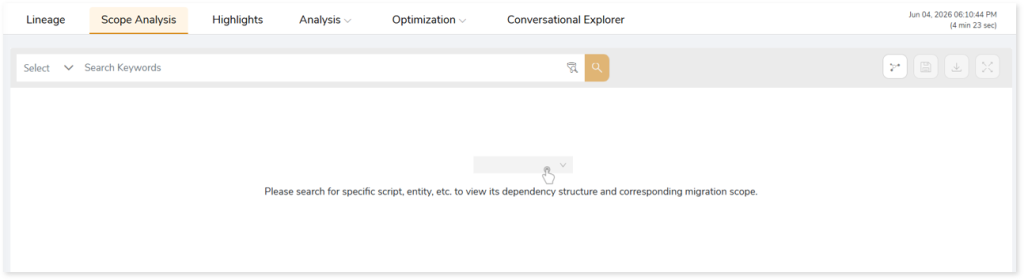
  1. Enter a job or entity (for example, an Informatica job) in the search field to initiate scope analysis.
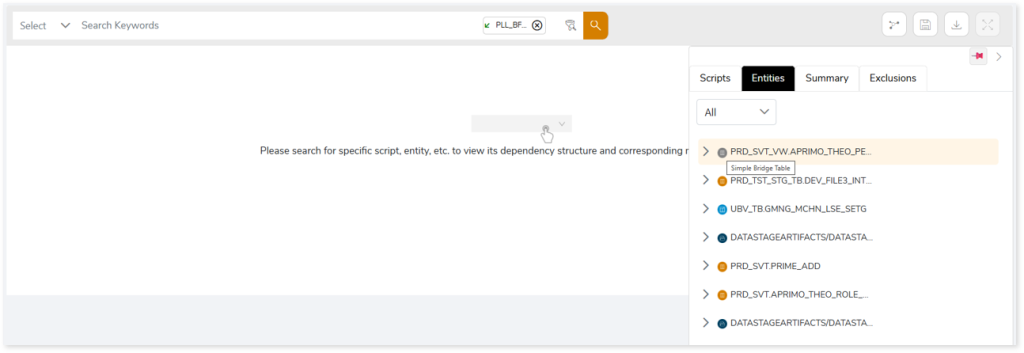
  1. The system identifies the initial scope by displaying all direct dependencies, including associated jobs, tables, files, views, scripts, etc. These represent the minimum set of components required to migrate the selected artifact.
  2. Some dependencies may appear as bridges (for example, bridge tables), indicating that the relationship is not fully resolved within the current scope. For example, a table used by the selected job may be written by another job that is not yet included. Bridges can represent different dependency scenarios (such as simple—direct dependency between two components or complex—dependency with multiple contributing sources or unclear execution order), which determine whether additional components need to be included in the scope.
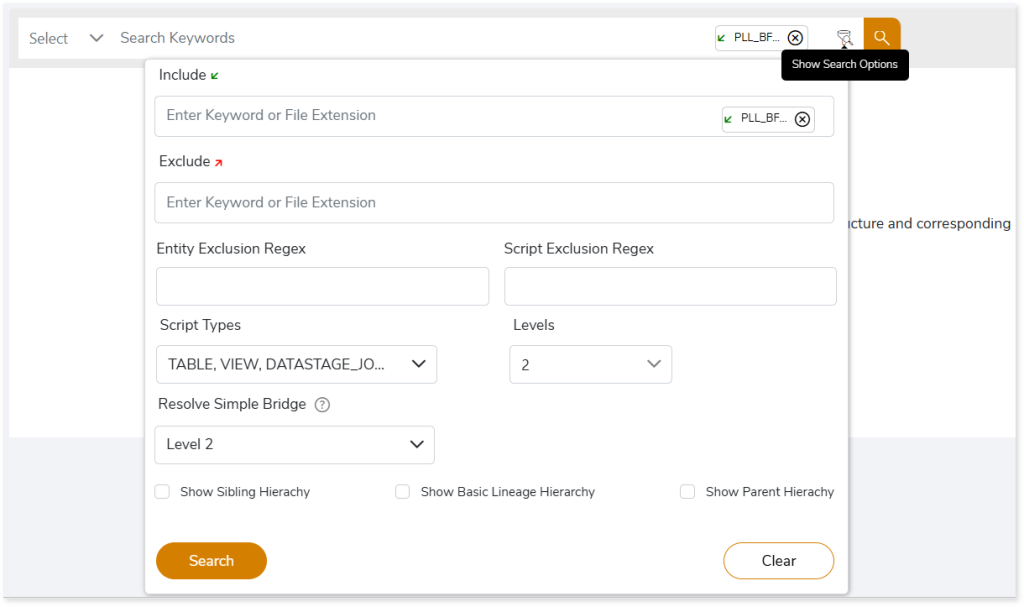
  1. You can expand the scope by increasing the level. Each level resolves pending dependencies (bridges) and additional related jobs, tables, files, scripts, etc., are automatically included.
    To increase the scope level:
    1. Click Show Search Options.
    2. In Levels, select the required level.
    3. In Resolve Simple Bridge, select a level if simple bridges need to be resolved. If no value is selected, only complex bridges are resolved by default.
    4. Click Search. This allows you to control which dependencies are included based on business requirements, available resources, or timelines.
  1. You can increase the levels so that dependencies are progressively resolved and additional components are included in the scope. This process continues until a complete and consistent scope is achieved. The results are displayed in the right-hand panel (Scripts, Entities, Summary, etc.).
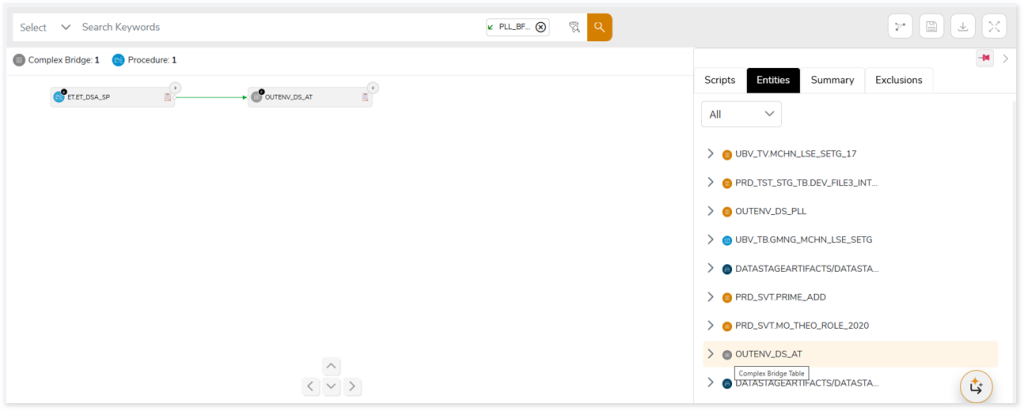
  1. The identified scope helps you determine:
    1. What components need to be migrated.
    2. The size and complexity of the workload.
    3. The effort required in terms of time and resources.

    To learn more, contact our support team or write to: info@leaplogic.io

    Copyright © 2026 Impetus Technologies Inc. All Rights Reserved

    • Terms of Use
    • Privacy Policy
    • License Agreement
    To the top ↑ Up ↑