AI Implementation Readiness Assessment
The AI Implementation Readiness Assessment evaluates how well your organization is prepared to modernize its workloads using AI. It leverages your enterprise profile and modernization context to assess AI implementation readiness through a structured, survey-based approach, generating a contextual readiness score.
Key Highlights
- Survey-driven assessment based on enterprise, platform, and AI context
- Evaluation across strategy, data, governance, technology, and operating model
- Identification of foundational blockers that may limit AI adoption
- Identification of AI implementation readiness gaps, including Legacy data and logic gap, Semantic readiness gap, and Execution readiness gap
- Assessment of modernization readiness with AI, ensuring workloads are prepared for AI-driven transformation
- Highlights gaps that may hinder AI-enabled modernization and require manual intervention
- Executive readiness scoring to benchmark preparedness and risk exposure
- Prioritized transformation roadmap with actionable recommendations
In This Topic:
Access AI Implementation Readiness Assessment
Follow these steps to access AI implementation readiness assessment:
- Log in to Impetus LeapLogic Lineage account.
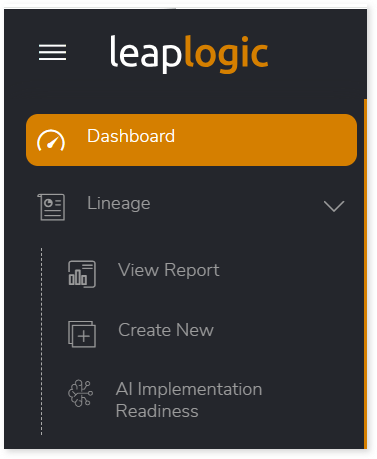
- From the left navigation pane, select Lineage > AI Implementation Readiness.
- The AI Implementation Readiness Assessment page opens. Configure the readiness profile by providing key enterprise, platform, and AI context.
- In Modernization Stage, select the modernization stage, such as Pre-migration / Planning Stage, Migration In Progress, or Migrated/ Cloud-Native Estate.
- In Industry Context, select the relevant domain (e.g., Finance, Sales, etc.).
- In Current/ Legacy Technology Stack, choose the existing legacy platform (e.g., Teradata, Netezza).
- In Target or Current AI/Data Platform, select the destination platform (e.g., AWS, Databricks).
- In Priority AI Use Cases, select applicable use cases aligned with the chosen industry context.
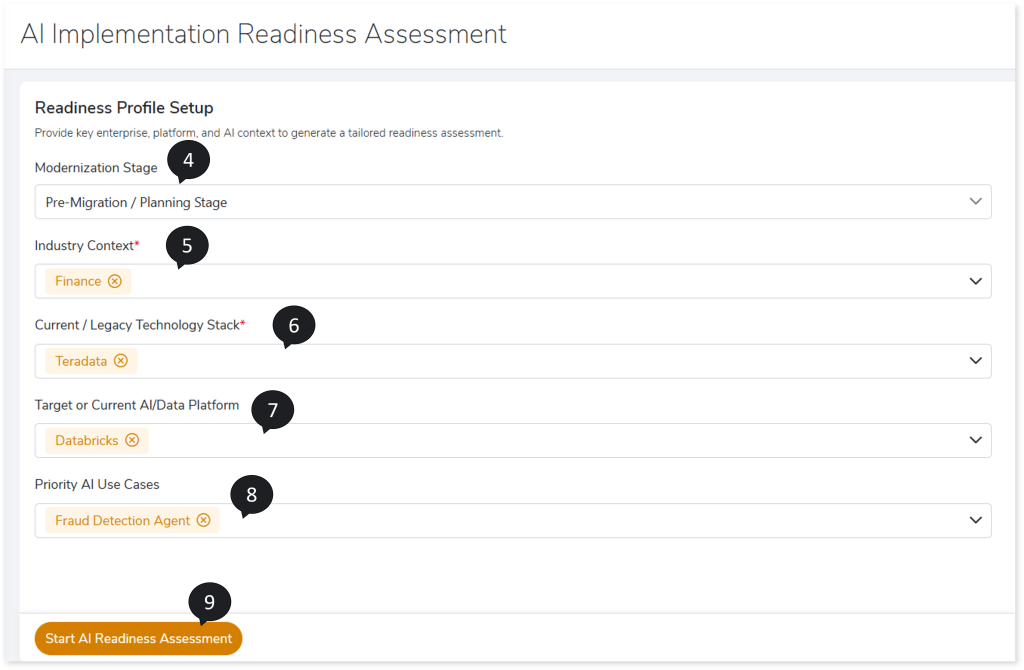
- Click Start AI Implementation Readiness Assessment.
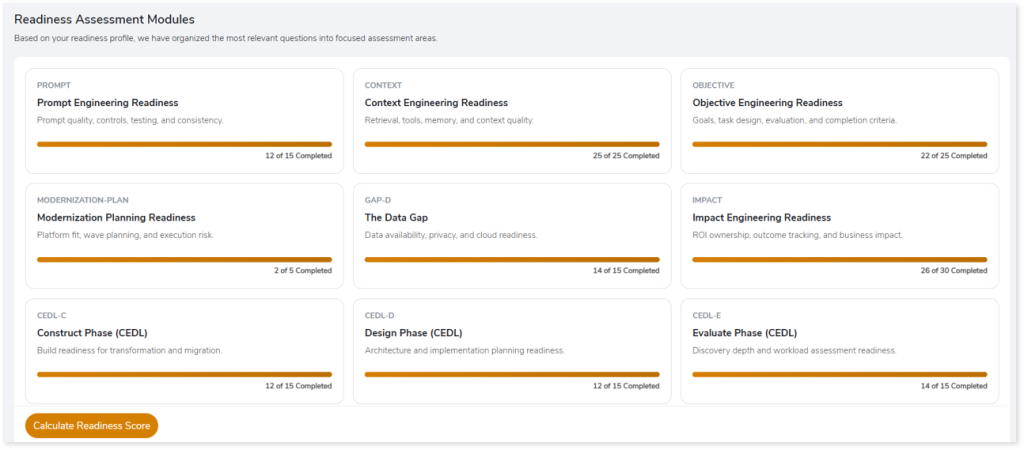
- Upon successful creation, a confirmation message is displayed and then The Readiness Assessment Modules page opens.

- Based on your readiness profile, LeapLogic AI organizes relevant questions into focused assessment areas. Complete the survey by answering all questions based on your prompt, context, objective, modernization plan, impact, CEDL, and more.
- Click Calculate Readiness Score.
- The system generates the LeapLogic AI Implementation Readiness Score, which includes, modernization Readiness, identified capability gaps and foundational blockers, and more.
Readiness Assessment Modules
Based on your defined readiness profile, the system organizes the most relevant questions into focused assessment modules. Each module represents a specific capability area and contains targeted questions to evaluate readiness and identify gaps.
To ensure an accurate assessment of AI implementation readiness, you must complete all questions within each module based on your workload and enterprise context.
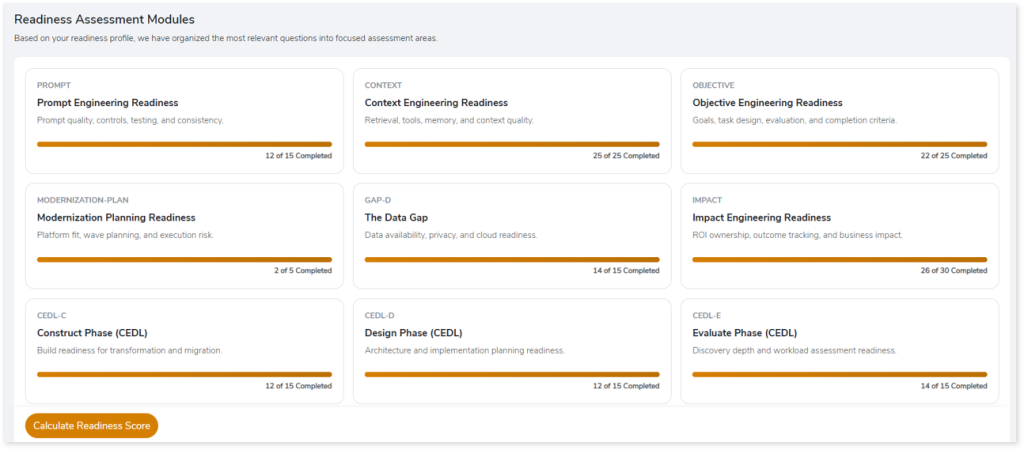
The modules include:
- Prompt Engineering Readiness: Focuses on prompt quality, control mechanisms, testing strategies, and consistency.
- Context Engineering Readiness: Evaluates retrieval mechanisms, tool integrations, memory handling, and overall context quality.
- Objective Engineering Readiness: Covers goal definition, task design, evaluation criteria, and completion benchmarks.
- Modernization Planning Readiness: Assesses platform alignment, wave-based planning, and execution risk.
- Impact Engineering Readiness: Measures ROI ownership, outcome tracking, and overall business impact.
- Construct Phase (CEDL-C): Build readiness for transformation and migration activities.
- Design Phase (CEDL-D): Architecture definition and implementation planning readiness.
- Evaluate Phase (CEDL-E): Discovery depth and workload assessment readiness.
- Launch Phase (CEDL-L): Validation, testing, and production cutover readiness.
- Legacy Estate Readiness (LEGACY-READINESS): Legacy system complexity, hidden business logic, and dependency mapping.
- Enterprise AI Profile: Enterprise scale, AI ambition, and governance baseline.
- Gap Analysis Modules: These modules specifically identify critical gaps that may impact AI-driven modernization:
- Data Gap (GAP-D): Data availability, privacy, and cloud readiness.
- Semantic Gap (GAP-S): Business meaning, data lineage, and metadata alignment.
- Execution Gap (GAP-E): Operational controls required for production-scale AI execution.
AI Implementation Readiness Score
The AI Implementation Readiness Score provides a consolidated view of your organization’s readiness to modernize workloads using AI. It presents a structured snapshot of capability maturity, identifies key gaps, and outlines recommended next steps for AI-driven modernization.
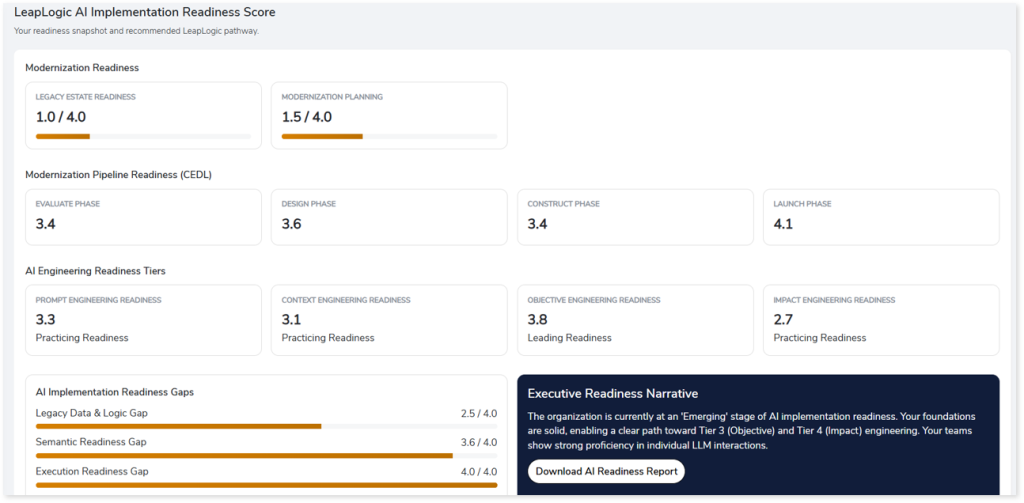
Score Overview
The readiness score is presented as a structured snapshot across the following areas:
- Modernization Readiness: Provides an overall view of foundational readiness for AI-driven modernization, including, Legacy Estate Readiness and Modernization Planning Readiness.
- Modernization Pipeline Readiness (CEDL): Reflects readiness across key stages of the transformation lifecycle such as Evaluate Phase, Design Phase, Construct Phase, and Launch Phase.
- AI Engineering Readiness Tiers: Measures maturity across core AI engineering capabilities including Prompt Engineering Readiness, Context Engineering Readiness, Objective Engineering Readiness, and Impact Engineering Readiness.
Each area is presented with a score and visual indicators to help you quickly interpret readiness levels.
AI Implementation Readiness Gaps
The assessment highlights critical gaps that may impact AI-driven modernization:
- Legacy Data & Logic Gap: Indicates challenges related to legacy systems, data structures, and embedded logic.
- Semantic Readiness Gap: Reflects misalignment in business context, metadata, and data meaning.
- Execution Readiness Gap: Identifies limitations in operational controls required for production-scale AI.
Addressing these gaps is essential to improve overall readiness and reduce dependency on manual intervention.
Executive Readiness Narrative
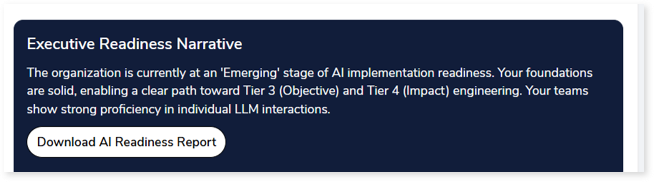
A contextual Executive Readiness Narrative summarizes your organization’s overall readiness position.
- Provides a maturity classification (for example, Emerging, Practicing, or Leading).
- Highlights strengths and areas of improvement.
- Outlines progression paths across AI engineering tiers.
- Aligns readiness insights with business impact and modernization goals.
Download AI Readiness Report
You can download a detailed report of the assessment results from the AI Implementation Readiness Score page. To download the report, click Download AI Readiness Report.
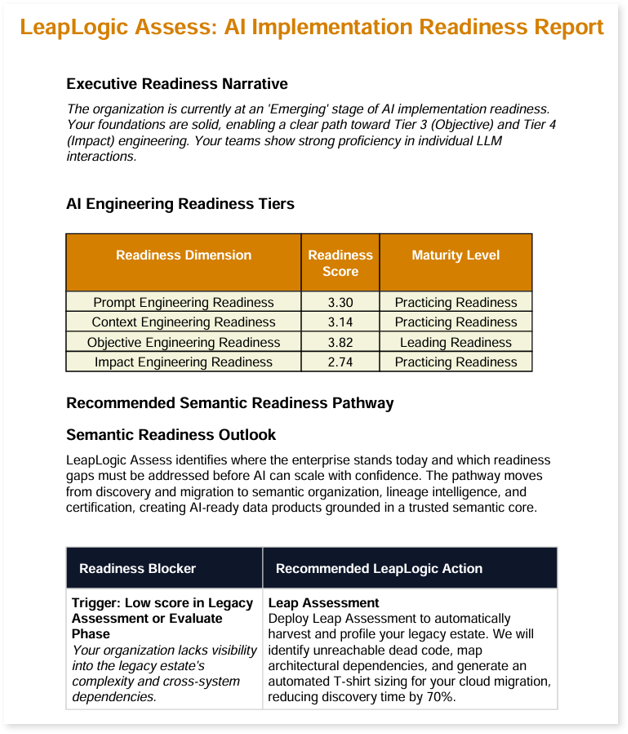
The downloaded report, LeapLogic Assess: AI Implementation Readiness Report, provides a detailed and structured view of your assessment outcomes. It includes:
- Executive Readiness Narrative: A summary of your organization’s AI readiness stage, key strengths, and progression path across AI engineering tiers.
- AI Engineering Readiness Tiers: A tabular view of readiness dimensions, including Prompt Engineering Readiness, Context Engineering Readiness, Objective Engineering Readiness, and Impact Engineering Readiness. Each dimension includes a readiness score and corresponding maturity level (for example, Practicing or Leading).
- Recommended Semantic Readiness Pathway: Provides guidance on improving semantic readiness by outlining a structured progression toward AI-ready data.
- Semantic Readiness Outlook: Describes the current state of enterprise readiness and highlights areas that need to be addressed for scalable AI adoption.
- Readiness Blockers and Recommended Actions: Identifies key blockers (for example, low legacy assessment scores or limited visibility into dependencies) and maps them to recommended LeapLogic actions such as automated assessment, dependency mapping, and modernization planning.
 Leaplogic