Scope Analysis
Scope Analysis is a strategic capability that enables you to move from data flow visibility to actionable scope definition. While lineage provides a comprehensive view of how data and processes traverse across systems, Scope Analysis builds on this foundation to determine what must be included for initiatives such as data migration, modernization, or re-engineering.
By leveraging lineage-driven relationships, Scope Analysis ensures that scope boundaries are established based on actual dependencies rather than assumptions. This enables you to accurately assess the required effort, including the time, resources, and development work needed to migrate workloads such as tasks, jobs, and related processes, thereby supporting effective planning and execution.
In This Topic:
Lineage vs Scope Analysis
Although Scope Analysis builds on lineage, the two capabilities differ in purpose, interaction model, and outcomes.
Lineage
- Provides upstream, downstream, or bidirectional lineage for a selected or searched node, enabling clear visibility into data and process flows.
- Delivers end-to-end lineage, helping identify complete dependency structures across systems.
- Supports interactive navigation and drill-down, allowing you to explore flows level by level to the lowest level of detail.
- Enables you to view and analyze dependencies without requiring decisions on inclusion or scope.
- Focuses on analysis, traceability, and understanding of how data moves across systems.
Scope Analysis
- Focuses on defining actionable scope for business or technical objectives such as migration, modernization, or re-engineering.
- Builds on lineage visibility to finalize scope boundaries based on actual dependencies.
- Allows you to define scope by resolving dependencies (bridges) based on business or technical requirements.
- Automatically identifies the first-level scope for a selected context without requiring direction selection.
- Resolves dependencies (bridges) to determine what must be included in the defined scope.
- Progression is dependency-driven, where moving to the next level resolves pending dependencies (bridges) to ensure a complete and accurate scope.
- Allows you to select which bridge types to resolve, providing control to avoid:
- Over-scoping (including unnecessary components)
- Under-scoping (missing critical dependencies)
- Displays only relevant entities within the defined scope, reducing noise and improving focus.
- Supports decision-making and execution planning, helping you determine what needs to be migrated or included to achieve a business objective.
Scope Analysis Capabilities and Usage
Scope Analysis provides a structured and controlled mechanism to define, refine, and validate scope boundaries based on dependency resolution.
- Scope Identification: Automatically identifies all first-level related processes and entities without requiring manual direction selection, accelerating initial scope creation.
- Dependency (Bridge) Resolution: Resolves interdependencies across systems to ensure a complete and consistent scope, minimizing the risk of missing critical components.
- Selective Scope Control: Enables you to choose which bridge types to resolve, allowing precise control over inclusion:
- Prevents over-scoping (unnecessary expansion)
- Avoids under-scoping (missing dependencies)
- Incremental Scope Refinement: Each progression step resolves pending dependencies rather than simply expanding the flow, resulting in a validated and execution-ready scope.
- Focused Visualization: Restricts the view to only those data elements and processes within the defined scope, improving clarity and reducing cognitive overhead.
- Execution-Oriented Planning: Clearly identifies what needs to be migrated, modernized, and re-engineered.
This ensures that all relevant dependencies are included to successfully achieve the intended business objective.
How Scope Analysis Works
Scope Analysis enables you to define and refine migration scope by progressively resolving dependencies.
- Enter a job or entity (for example, an Informatica job) in the search field to initiate scope analysis.
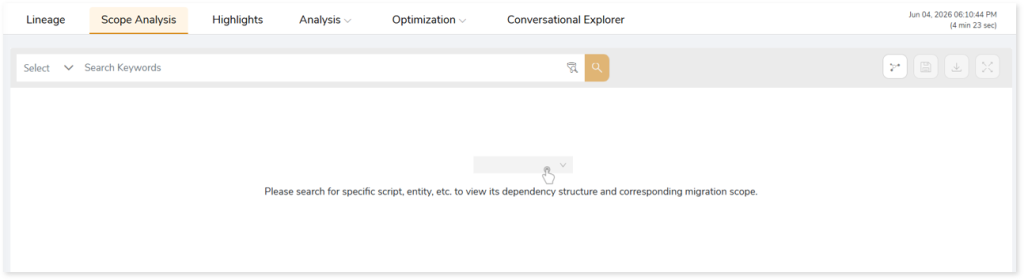
- The system identifies the initial scope by displaying all direct dependencies, including associated jobs, tables, files, views, scripts, etc. These represent the minimum set of components required to migrate the selected artifact.
- Some dependencies may appear as bridges (for example, bridge tables), indicating that the relationship is not fully resolved within the current scope. For example, a table used by the selected job may be written by another job that is not yet included. Bridges can represent different dependency scenarios (such as simple—direct dependency between two components or complex—dependency with multiple contributing sources or unclear execution order), which determine whether additional components need to be included in the scope.
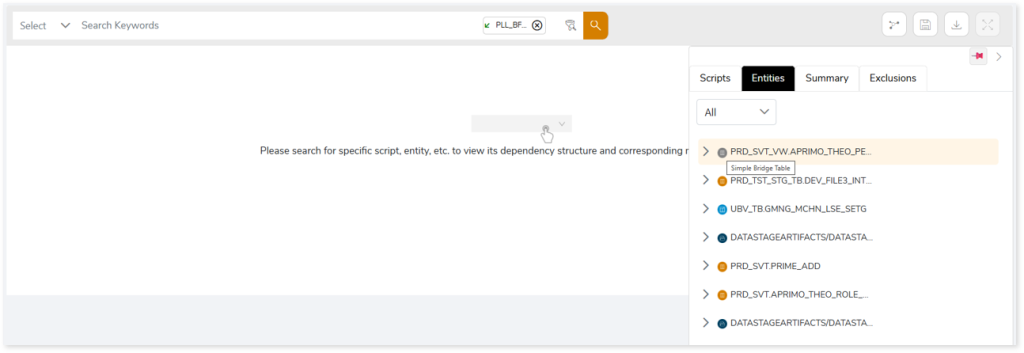
- You can expand the scope by increasing the level. Each level resolves pending dependencies (bridges) and additional related jobs, tables, files, scripts, etc., are automatically included.
To increase the scope level:
- Click Show Search Options.
- In Levels, select the required level.
- In Resolve Simple Bridge, select a level if simple bridges need to be resolved. If no value is selected, only complex bridges are resolved by default.
- Click Search. This allows you to control which dependencies are included based on business requirements, available resources, or timelines.
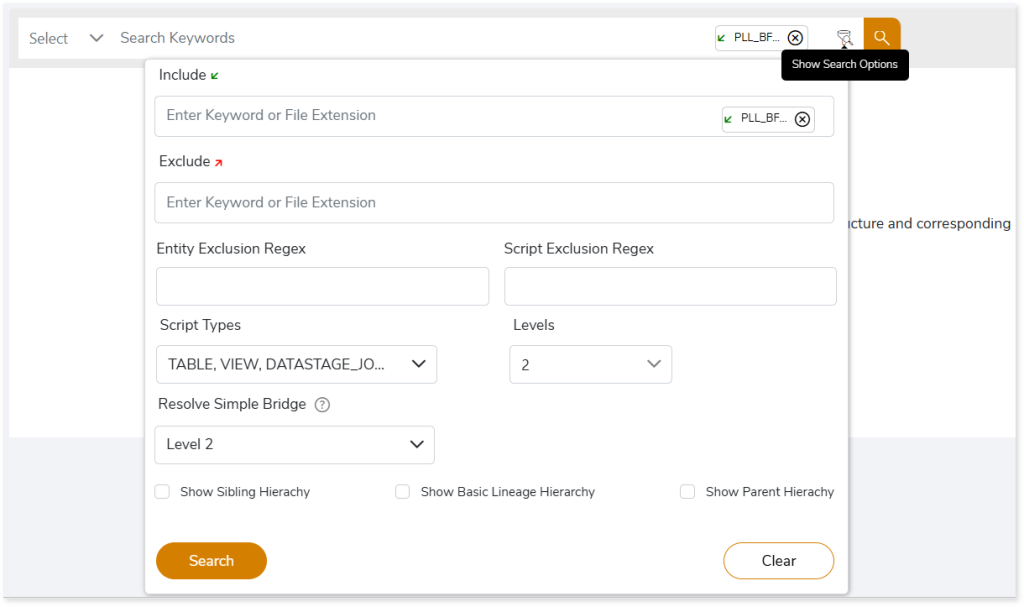
- You can increase the levels so that dependencies are progressively resolved and additional components are included in the scope. This process continues until a complete and consistent scope is achieved. The results are displayed in the right-hand panel (Scripts, Entities, Summary, etc.).
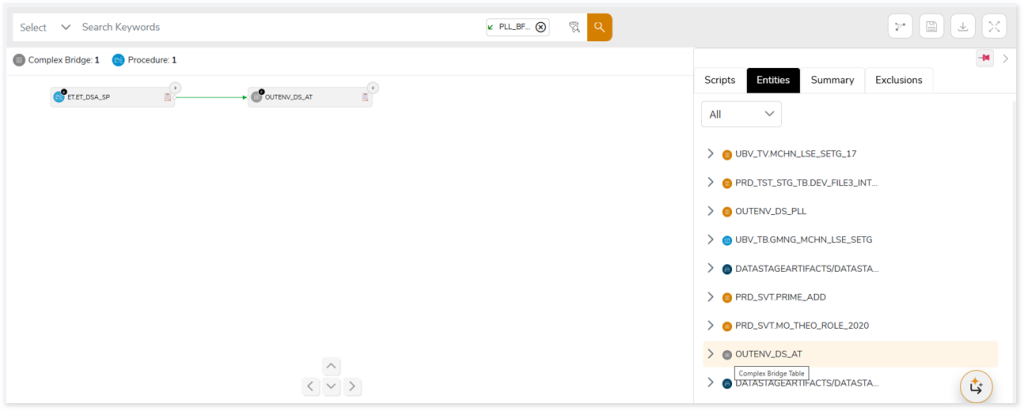
- The identified scope helps you determine:
- What components need to be migrated.
- The size and complexity of the workload.
- The effort required in terms of time and resources.
 Leaplogic