SAS Conversion Report
This topic provides a comprehensive report of SAS conversion. The analytics conversion pipeline converts legacy SAS workloads to modern cloud platforms.
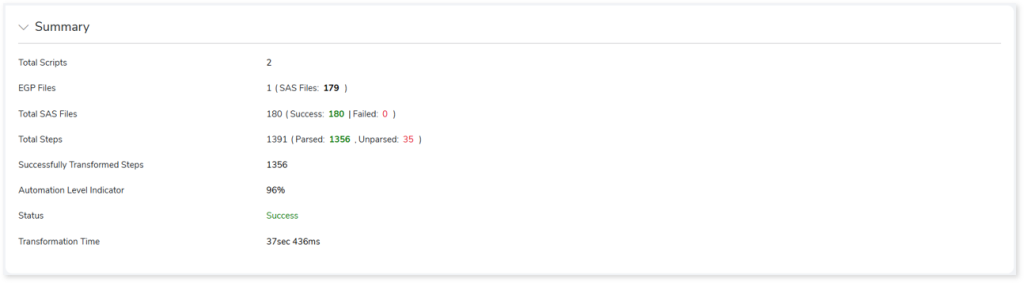
- Total Scripts: Displays the number of scripts you have given as input in the Analytics Conversion Stage.
- EGP Files: Displays the number of uploaded EGP files. It also displays the number of SAS files in the EGP files.
- Total SAS Files: Displays the total number of uploaded SAS files. It also includes the number of successfully converted and failed files.
- Total Steps: Displays the total number of statements present in the script along with the number of parsed and unparsed statements.
- Successfully Transformed Steps: Displays the number of statements successfully transformed.
- Automation Level Indicator: Displays the automation conversion coverage.
- Status: Provides status of the Analytics conversion stage.
- Transformation Time: The time taken for conversion.
In This Topic:
Report
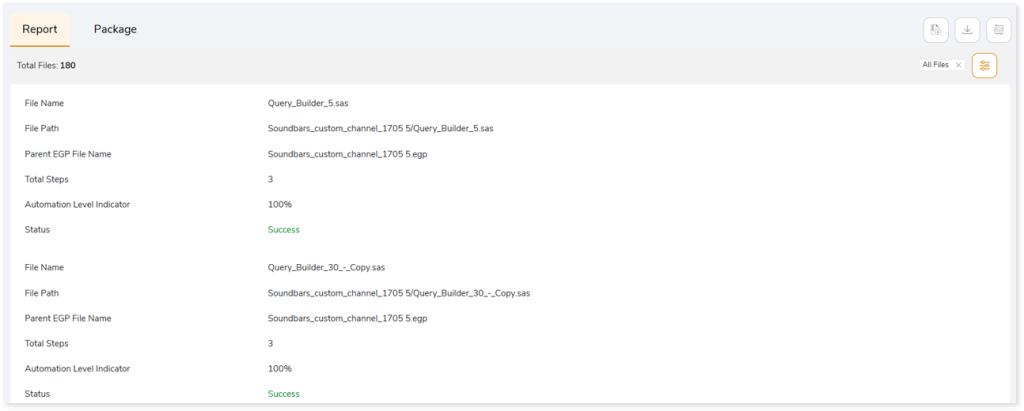
This topic lists all the input files. It provides information about the name of the files, file path, parent EGP files, the number of statements, status, and more.
Package
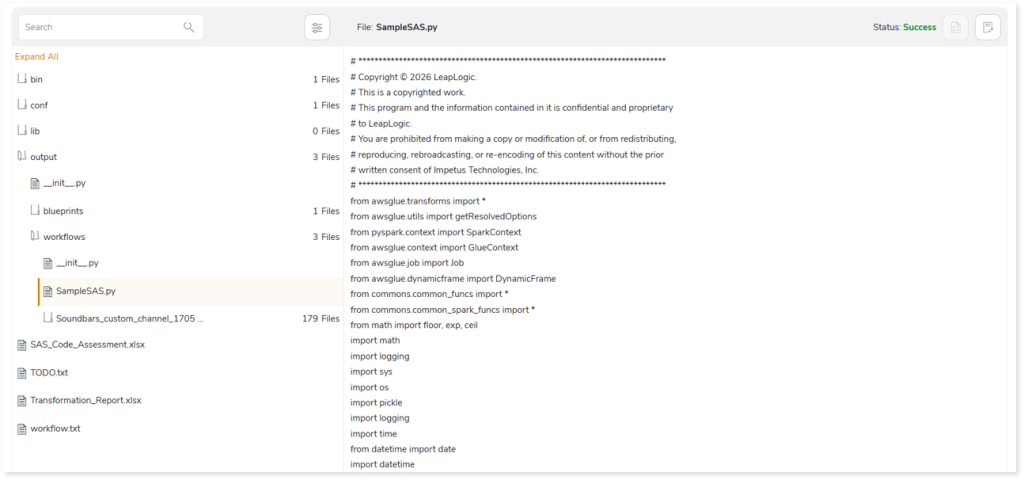
This topic provides the transformed artifacts containing Python file that can be executed on the target platform. Select  to download the converted artifacts for offline use.
The Package section contains several folders and reports, including:
- output folder: Contains the target-equivalent Python artifacts.
- SAS_Code_Assessment.xlsx: Provides insights about the source inventory. It helps you plan the next frontier of a modern data platform methodically. It includes information about complexity measures, functions, variable references, EGP summary, and more.
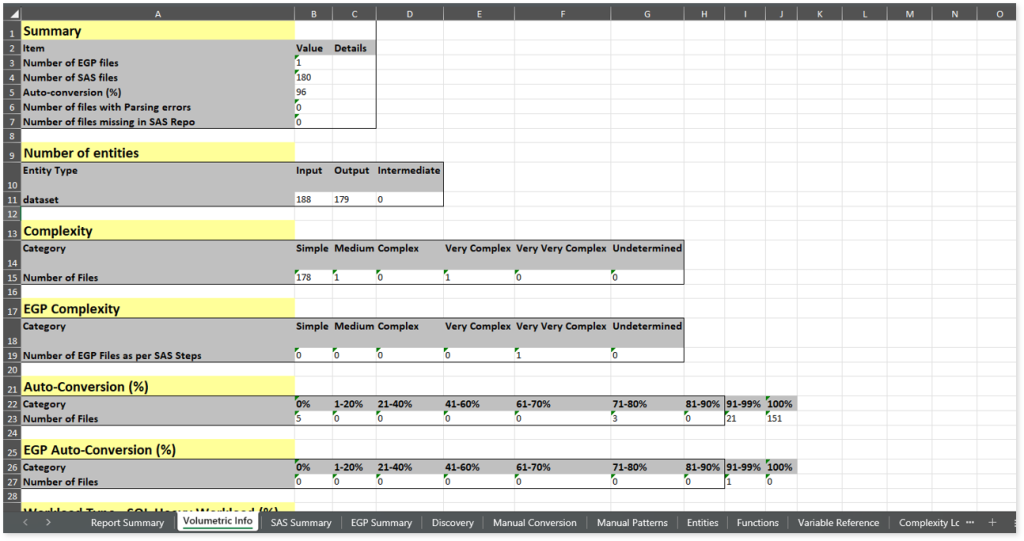
This report contains the following information:
- Report Summary: Provides information about all the generated artifacts.
- Volumetric Info: Presents a summary of the aggregated inventory after analyzing the source files. For instance, it provides information about the number of files with parsing errors, missing files, extent of auto-conversion, complexity of SAS and EGP files, and so on.
- SAS Summary: Provides detailed information about all SAS files along with high-level complexity details of each SAS file. It includes information about the formula used to derive the complexity, total lines of code, percentage of auto-conversion, number of valid lines of code for conversion, statements, PROC SQLs, and a lot more.
- EGP Summary: Provides details about the EGP files. It includes information about auto-conversion percentage, aggregated complexity as per SAS steps, total number of lines of code, number of non-converted code lines, count of PROC SQL statements, complexity, and so on.
- Discovery: Lists key metrics related to auto-converted code. It includes code parsing status, percentage of auto-conversion, SAS task types, and likewise.
- Manual Conversion: Provides more granular auto-conversion metrics such as statements like format, date, length, increment, etc., that need manual intervention. It also provides the count of statements, procs, etc. that need manual intervention in the format “ToDo Automatic Comment “.
- Step 1: In the Discovery sheet, if Parsing status are failed consider it for manual conversion.
- Step 2: In the Missing Source Code sheet, if you find an entry there, do not proceed with the manual conversion. We need to first get the missing files from the customer and then do the end-to-end conversion.
- Step 3: In the Manual conversion sheet, if % auto-conversion is more than 20% then ask for code re-conversion and statement-wise count for manual conversion.
- Step 4: In the Manual Patterns sheet, refer to the details of code blocks that need manual conversion.
- Manual Patterns: Provides details of code blocks that need manual conversion. It includes information about the statement types which are not auto-converted, code for manual conversion, partially auto-converted code but requires minor changes, and describes actions required for manual conversion.
- Entities: Lists all the entities existing in the SAS file along with their type, operation type, reference value, and so on.
- Functions: Lists all the functions in the source scripts along with their target equivalent function, conversion strategy, etc.
- Variable Reference: Lists all the variables in a source SAS file along with their value appearing in the code. It also lists the entity types such as macro call, LET, etc.
- Parsing Errors: Provides information about unparsable code.
- Dependent Source Code: Lists dependent files for different source files.
- Complexity Logic: Provides complete high-level details required for complexity calculations of SAS and EGP files. It includes information about the Group Statements – collection of statements and lists all the SAS base functions. It also provides the complexity range based on an established complexity calculation logic, the assessment engine calculates the complexity of SAS scripts and their components and shows it in a range format for each SAS statement type and function. For .egp files, it provides the definition for the aggregated complexity of the EGP files.
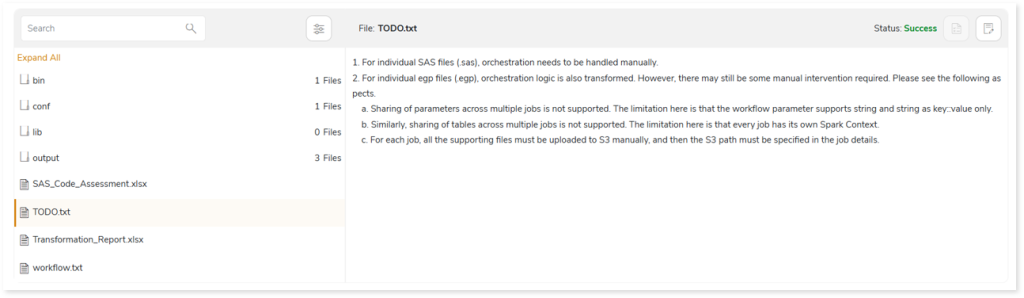
- TODO.txt: Lists files or elements that could not be automatically converted and require manual intervention.
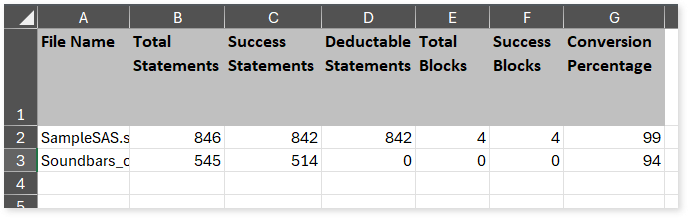
- Transformation_Report.xlsx: Provides a comprehensive summary of the SAS transformation, including the auto-conversion percentage for each transformed file.
 Leaplogic